Dispensing nozzle: virtual bench
This virtual bench completes the pressure/flow, dimensional sensitivity and dosing run-through using declared inputs. No instrument data were collected. Every generated observation is marked synthetic.
Equations and units
The slow-taper resistance is R = (8 mu / pi) integral dz / r(z)^4, in Pa s/mm3 when geometry is in mm. A linear radius segment integrates to L (r0^-3 - r1^-3) / [3 (r1-r0)]. Three new FEM solutions check this reduction at nominal and tolerance corners. The maximum observed FEM/reduced ratio receives a further 0.5% allowance; it is a local empirical bound, not a general error theorem.
Upstream straight-tube pressure is Q Rfeed. The bounded meniscus head is 2 gamma / rout with radius in metres. This is a static spherical-meniscus sensitivity with contact-angle cosine bounded by 1; it does not simulate droplets. The tolerance envelope uses independent corner/nominal radii, land length, viscosity and flow: 243 cases. It retains the original 6500 Pa pressure budget. The output derives a lower permitted flow instead of silently moving the budget.
For dosing, C dP/dt = (Ps-P)/Rfeed - (P-Pcap)/Rnozzle while open. The inlet is isolated at closure and C dP/dt = -(P-Pcap)/Rnozzle afterward. C = Vliquid/Kbulk + Vair/Pabsolute. Exact exponentials give pulse volume, tail and remaining stored liquid. The linear gas-compliance approximation is used only for the few-kPa pressure swing; it models a compressible pocket, not moving bubbles. Pressure is initially Pcap. The inlet valve is assumed instantaneous. Tail liquid leaves the nozzle; droplet detachment is not computed.
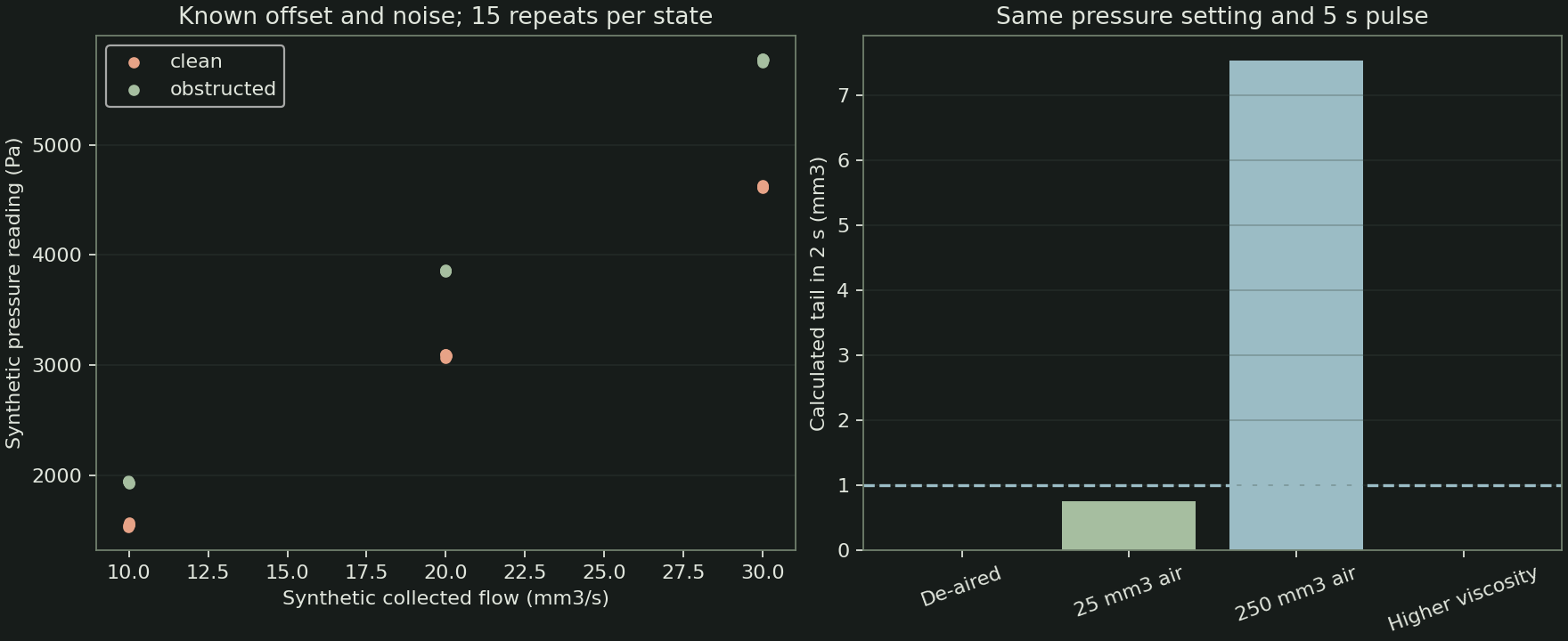
The synthetic bench imposes a common 22 Pa offset and 12 Pa independent normal noise on pressure, plus 0.2 mg balance noise over 20 s at the declared 1 mg/mm3 density. Fitting an intercept prevents the imposed zero offset from being mistaken for resistance. A seeded 25% obstruction challenge tests detection. This verifies the inference workflow against known generated truth; it is not independent physical validation of the flow solver.
Selected operating decision
The existing wide-inlet CAD is retained. The combined system envelope is limited to 26.4 mm3/s at 0.5 to 1.0 Pa s with the declared tolerances, feed tube and meniscus bound. Its worst computed pressure is 6478.60 Pa. The 30 mm3/s endpoint is rejected for this envelope. No dimensions were changed and no new CAD revision is implied.
For the separate 100 mm3 pulse example, use the nominal 0.75 Pa s de-aired condition. A change of viscosity or gas compliance requires a new regulator/pulse calculation; the failed fixed-setting cases are not approved operating points.
Acceptance results
| requirement | outcome | evidence |
|---|---|---|
| 6500 Pa at 30 mm3/s, tolerance + supply + meniscus | FAIL | Worst 7323.08 Pa; original nominal-only maximum was 6142.62 Pa. |
| Computed conservative operating range | PASS | Up to 26.4 mm3/s across this bounded input set; maximum 6478.60 Pa. |
| Nominal fixed pulse 100 +/- 1 mm3 | PASS | De-aired pulse 99.999963 mm3. |
| Shutoff after large air pocket | FAIL | 7.540 mm3 tail in 2 s exceeds 1 mm3. |
| Unchanged setting after viscosity increase | FAIL | 75.000 mm3 during pulse. |
FEM comparison at tolerance corners
| case | inlet radius mm | outlet radius mm | outlet land mm | fem pressure Pa | reduced pressure Pa | relative error |
|---|---|---|---|---|---|---|
| minimum_resistance | 1.26 | 0.51 | 1.8999999999999986 | 2824.5135119318707 | 2818.2235310040464 | 0.002226925416094816 |
| nominal | 1.25 | 0.5 | 2.0 | 3071.309379681716 | 3064.5755390976 | 0.0021924982968709594 |
| maximum_resistance | 1.24 | 0.49 | 2.1000000000000014 | 3345.278757753122 | 3338.049964044233 | 0.002160894272901892 |
Dosing and shutoff
| case | air volume mm3 | viscosity factor | compliance mm3 Pa | steady flow mm3 s | pulse mm3 | tail mm3 | stored at close mm3 | remaining mm3 | inlet volume mm3 | tau on s | tau off s | closure pressure Pa | balance residual mm3 | pulse error mm3 | pulse pass | tail pass |
|---|---|---|---|---|---|---|---|---|---|---|---|---|---|---|---|---|
| deaired | 0 | 1 | 2.5e-07 | 20.0 | 99.99996278200436 | 0.000767827344920429 | 0.000767827344920429 | 0.0 | 100.00073060934929 | 1.8608997818250052e-06 | 3.8391367246021454e-05 | 3351.309379681716 | 9.654169824679926e-15 | -3.7217995640048684e-05 | True | True |
| small_air_pocket | 25 | 1 | 0.0002469808166790032 | 20.0 | 99.96323147617017 | 0.7585544988676729 | 0.7585544988676729 | 9.524123901827374e-24 | 100.72178597503783 | 0.0018384261914916743 | 0.037927724943383645 | 3351.309379681716 | -5.551115132649906e-15 | -0.036768523829834976 | True | True |
| large_air_pocket | 250 | 1 | 0.0024675581667900318 | 20.0 | 99.6326497236624 | 7.5399634371012025 | 7.578634542572445 | 0.038671105471242355 | 107.21128426623484 | 0.018367513816880322 | 0.3789317271286223 | 3351.309379681716 | -4.85722573273506e-17 | -0.36735027633760353 | True | False |
| high_viscosity_same_setting | 0 | 1.3333333333333333 | 2.5e-07 | 15.000000000000002 | 74.99996278200437 | 0.0007678273449204291 | 0.0007678273449204291 | 0.0 | 75.0007306093493 | 2.481199709100007e-06 | 5.118848966136193e-05 | 3351.3093796817166 | 9.654061404462677e-15 | -25.000037217995626 | False | True |
Verification
| id | description | expected | observed | passed | method |
|---|---|---|---|---|---|
| resistance_pipe | Constant-radius reduction | matches 8 mu L/(pi r^4) to 1e-12 | 38.19718634205488 | True | Independent closed-form benchmark |
| fem_minimum_resistance | Reduced resistance checked at minimum_resistance | relative pressure error < 0.01 | 0.002226925416094816 | True | New axisymmetric P2/P1 Stokes solve at 120x24 mesh |
| fem_nominal | Reduced resistance checked at nominal | relative pressure error < 0.01 | 0.0021924982968709594 | True | New axisymmetric P2/P1 Stokes solve at 120x24 mesh |
| fem_maximum_resistance | Reduced resistance checked at maximum_resistance | relative pressure error < 0.01 | 0.002160894272901892 | True | New axisymmetric P2/P1 Stokes solve at 120x24 mesh |
| adverse_pressure_detected | Upper range including tolerances, feed and meniscus | at least one 30 mm3/s case exceeds unchanged 6500 Pa budget | 7323.080924347813 | True | Full factorial reduced-order tolerance study; checked FEM correction |
| guardband | Conservative flow bound from the same model | pressure <= 6500 Pa for every enumerated case | 6478.59692771179 | True | Worst permissible flow rounded down to 0.1 mm3/s; original target retained |
| creeping_regime | Flow regime over tolerance envelope | max Re < 0.1 | 0.07795344151439773 | True | Outlet diameter and mean velocity |
| synthetic_fit | Recover a declared resistance despite pressure offset/noise | relative slope error < 1% in both cases | 0.0031243688050183183 | True | Least squares with intercept on 3 flows x 5 repeats; seed recorded |
| obstruction | Detect synthetic added restriction | fitted resistance increase > 20% | 0.24611992667555804 | True | 25% resistance challenge compared with clean run |
| volume_balance | Compliant dosing volume balance | absolute residual < 1e-10 mm3 | 9.654169824679926e-15 | True | Closed-form inlet = pulse + tail + stored remainder |
| zero_compliance | Zero-compliance limiting case | 100 mm3 delivered during pulse and zero tail | 100.0 | True | Analytical steady resistance network |
| adverse_air | Large trapped air affects shutoff | 250 mm3 air case exceeds 1 mm3 tail criterion | 7.5399634371012025 | True | Linear isothermal gas-compliance sensitivity; no bubble transport claim |
| adverse_viscosity | Fixed pulse is not a volume controller | 1 Pa s case misses 100 +/- 1 mm3 target | 74.99996278200437 | True | Same regulator setting and pulse length; changed viscosity |
| input_rejection | Invalid resistance inputs | 3 invalid cases rejected | 3 | True | Zero bore, duplicate station and nonfinite viscosity |
Model boundary
The study does not select a commercial pump, material, seal or thread. Surface finish, cleaning chemistry, wear and non-Newtonian behavior cannot be inferred from these declared properties. Physical qualification remains a different evidence category. The completed deliverable is the reproducible computational assessment and its operating envelope.
Method references: Ansys fully developed laminar-flow verification; DOLFINx Taylor-Hood formulation. The resistance-network and compliance equations above are derived directly from flow and volume balances.