Field maintenance · Application engineering
Offline service notes
A service-notes app that saves checklists and drafts on the device. It queues changes for sync and lets a technician review both versions when edits conflict.
Implemented with executed synthetic and operational validation
Implementation
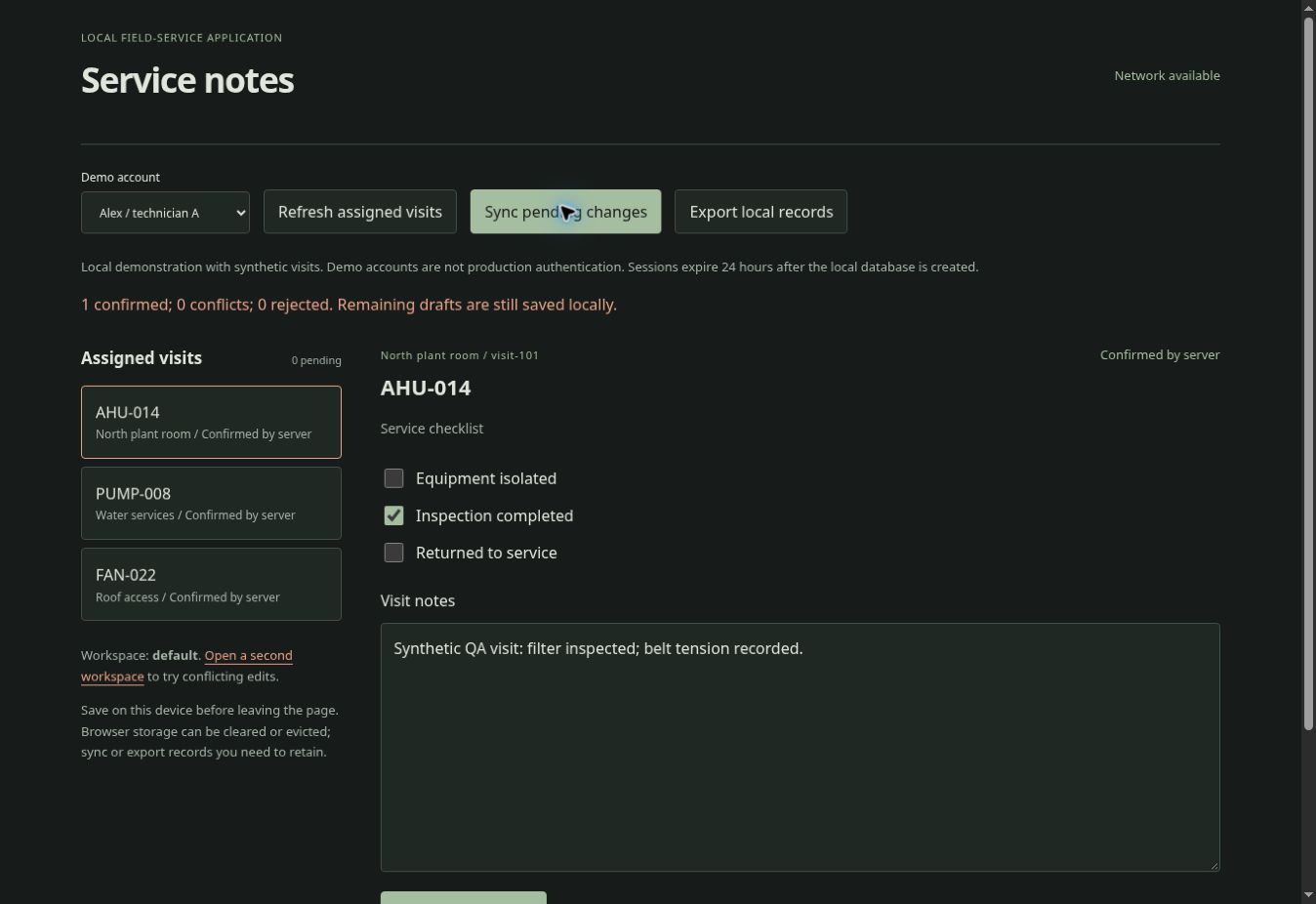
The browser saves a note and its outgoing operation in one IndexedDB transaction. Attempted operations retain their ID and payload for retry.
The Node API checks visit assignments and base versions, then commits the record change and replay response together in SQLite. A repeated operation returns the original outcome without another version increment.
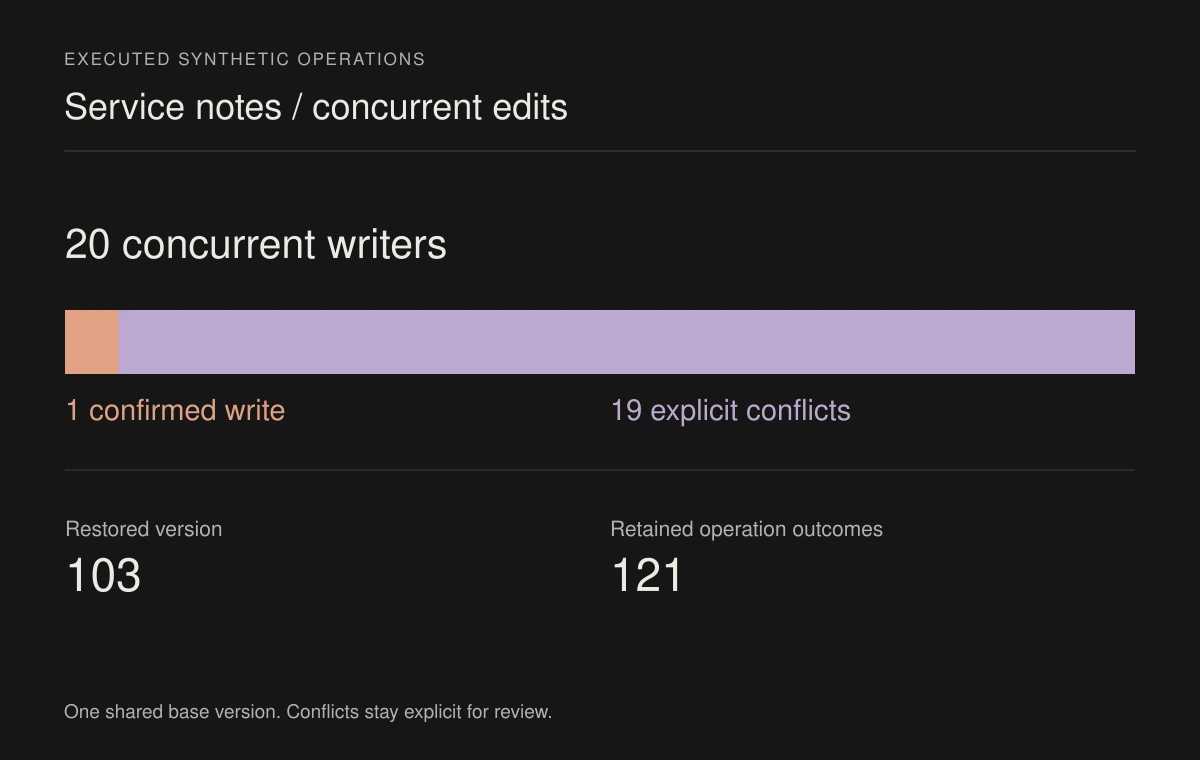
The interface shows pending, confirmed, conflicted, and rejected records. Conflict review retains both versions, and a JSON export includes saved records, pending operations, and history.
The shell cache handles connection loss and HTTP 503, upgrades its own scoped cache and reports eviction. Snapshot and restore commands verify SQLite integrity, row counts and file digests.
Inputs and assumptions
- Three synthetic service visits and public demo identities are included. Sessions expire 24 hours after database creation.
- A localhost Node.js 24 server and a modern browser with IndexedDB are required. The service-worker shell requires HTTPS or localhost.
- The data model contains text notes and three Boolean checklist fields; it has no photo attachments.
Results
| HTTP and SQLite checks passed | 15 / 15 |
|---|---|
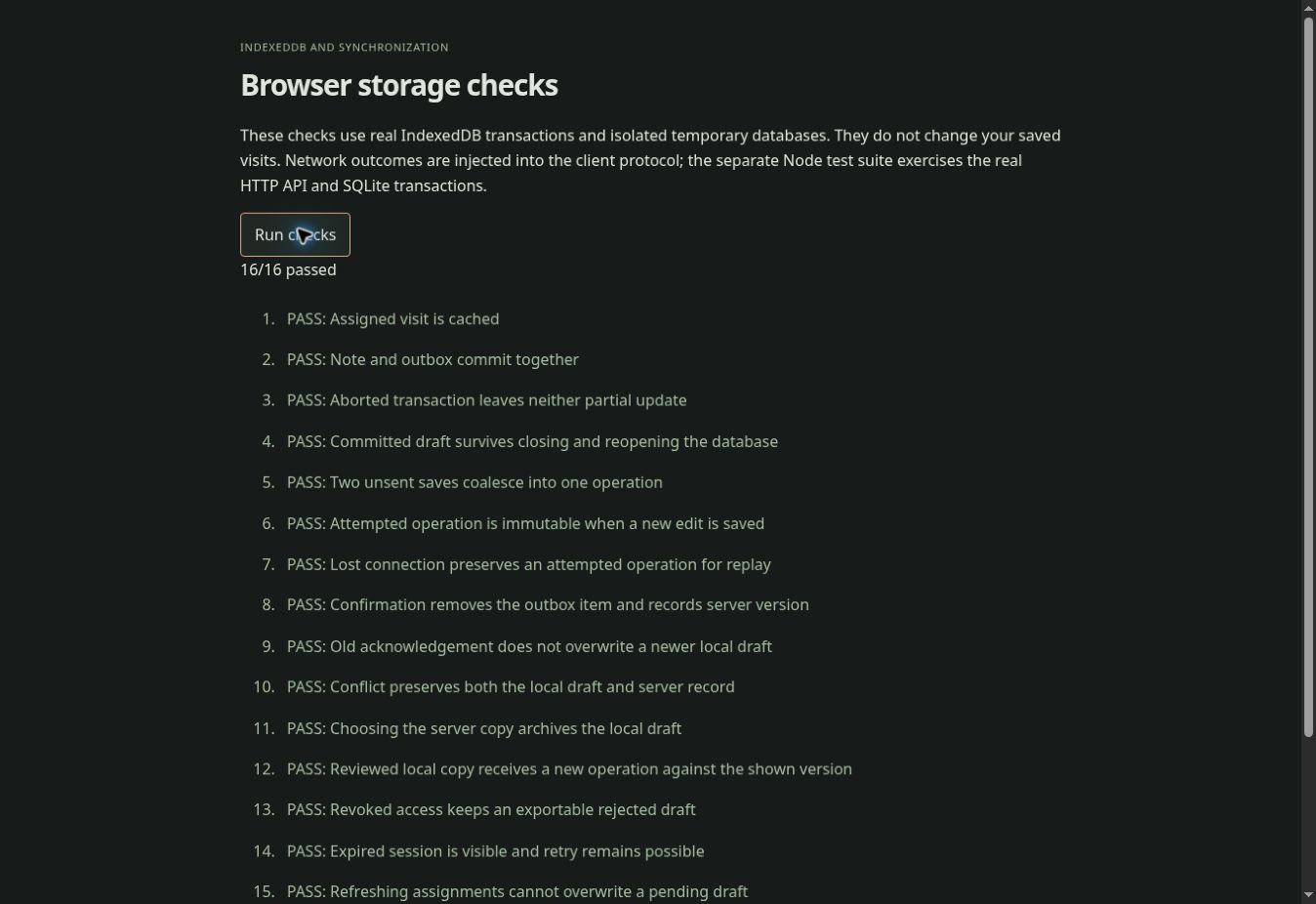
| Browser IndexedDB checks passed | 16 / 16 |
| Observed application workflows | Save/sync and two-workspace conflict resolution |
| Extended validation outcomes matched | 39 |
| Browser environment substitute | Executed worker lifecycle model |
Report figures (2)
Verification
15 HTTP/SQLite tests and 16 separately observed Chrome IndexedDB checks. Added 13 worker-source simulations, 11 real process/recovery checks, five snapshot CLI checks and 10 theoretical deployment cases.
node verify.mjsAdditional scenarios
39 outcomes checked through executed synthetic operations and theoretical deployment. The report lists the expected and observed outcomes for each check.
Read the validation report ↗Project files
The ZIP contains the source, inputs, results, and instructions. These files are also available individually.
- Node API and SQLite transactionsserver.mjs · 9 KB
- IndexedDB draft and outbox storepublic/store.mjs · 6 KB
- Synchronization protocolpublic/protocol.mjs · 2 KB
- Application interface logicpublic/app.mjs · 6 KB
- HTTP and database teststest-server.mjs · 5 KB
- Executed API test logresults/api-tests.tap · 3 KB
- Recorded browser verificationresults/browser-verification.json · 2 KB
- Setup, usage, and limitsREADME.md · 7 KB
- Extended verification reportcompletion-report.html · 15 KB
- Acceptance matrix and source hashescompletion.json · 17 KB
- Operation, recovery and deployment assessmentOPERATIONS.md · 6 KB
- Worker lifecycle simulationtest-sw.mjs · 8 KB
- Verified SQLite snapshot commandsnapshot.mjs · 2 KB
- Snapshot restore commandrestore.mjs · 2 KB
Archive checksum
SHA-256
2e0f53dcaf46a176ca227ee7dc9233eb8c150a9109ddee52c8bd1a2ed787f395Original project scope
Archived brief PDF ↗Run locally
Node.js 24 or newer / SQLite via node:sqlite / Modern browser with IndexedDB
Extract the ZIP and open a terminal in the offline-service-notes folder. The README includes setup and usage details.
node verify.mjs
node server.mjs
# Open http://localhost:8787
node complete.mjs
Limits
- Public fixture tokens are a demonstration mechanism, not production authentication. The server is restricted to localhost.
- Browser storage can be cleared or evicted. Saved records should be synchronized or exported when they must be retained.
- The browser harness uses simulated transport failures; the separate API tests use real HTTP and SQLite. No physical-device or cross-browser test coverage is claimed.
- Secure-context worker installation is represented by an executed lifecycle/cache model; an observed Chrome offline reload is not claimed.
- Remote hosting and identity received a theoretical deployment assessment. The shipped application uses localhost and synthetic identities.