Vibration analysis
Skid vibration isolation
A vertical and pitch isolation study for a rotating-equipment skid. It compares support stiffness and damping, startup resonance, foundation motion and load variation.
Coupled dynamics study with executed uncertainty and transient checks
Implementation
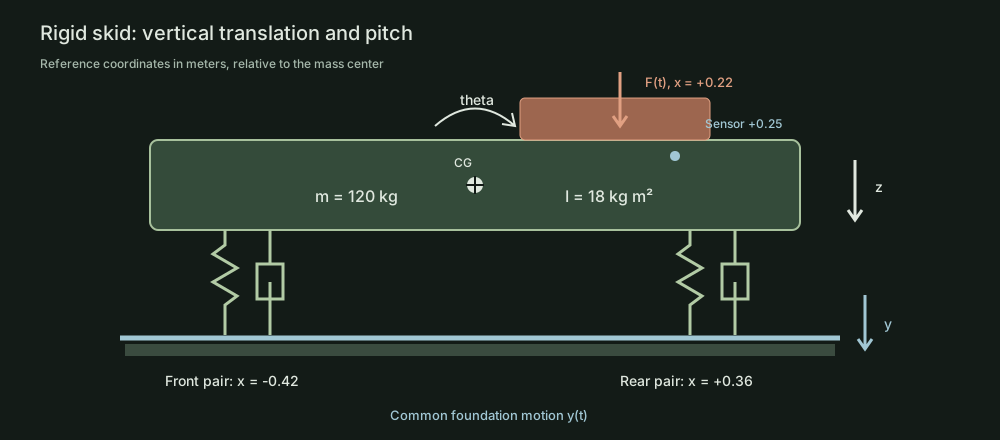
A two-degree-of-freedom rigid-body model couples vertical translation and pitch through asymmetric support pairs.
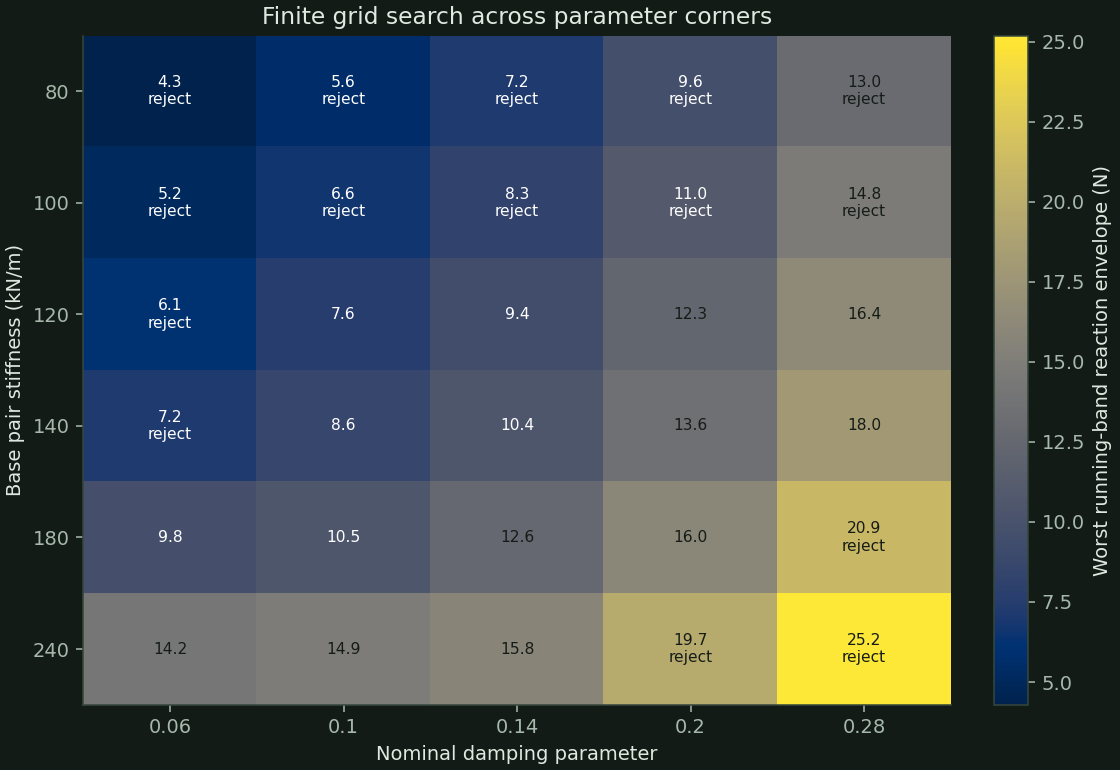
Complex frequency-response calculations compare a finite grid of 30 support choices over 32 parameter corners.
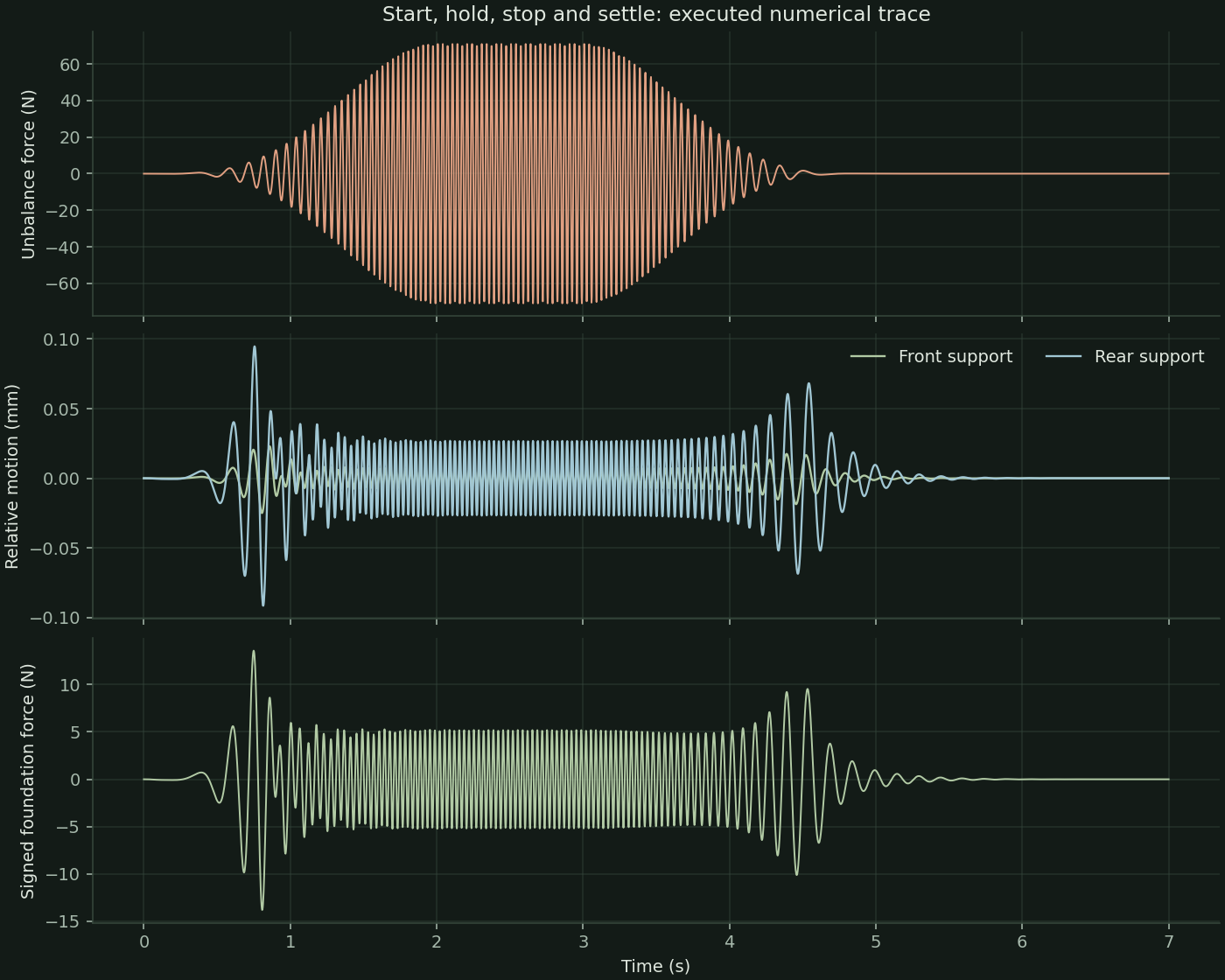
A smooth angular-frequency schedule is integrated analytically; its radial and angular-acceleration forces drive the transient ODE.
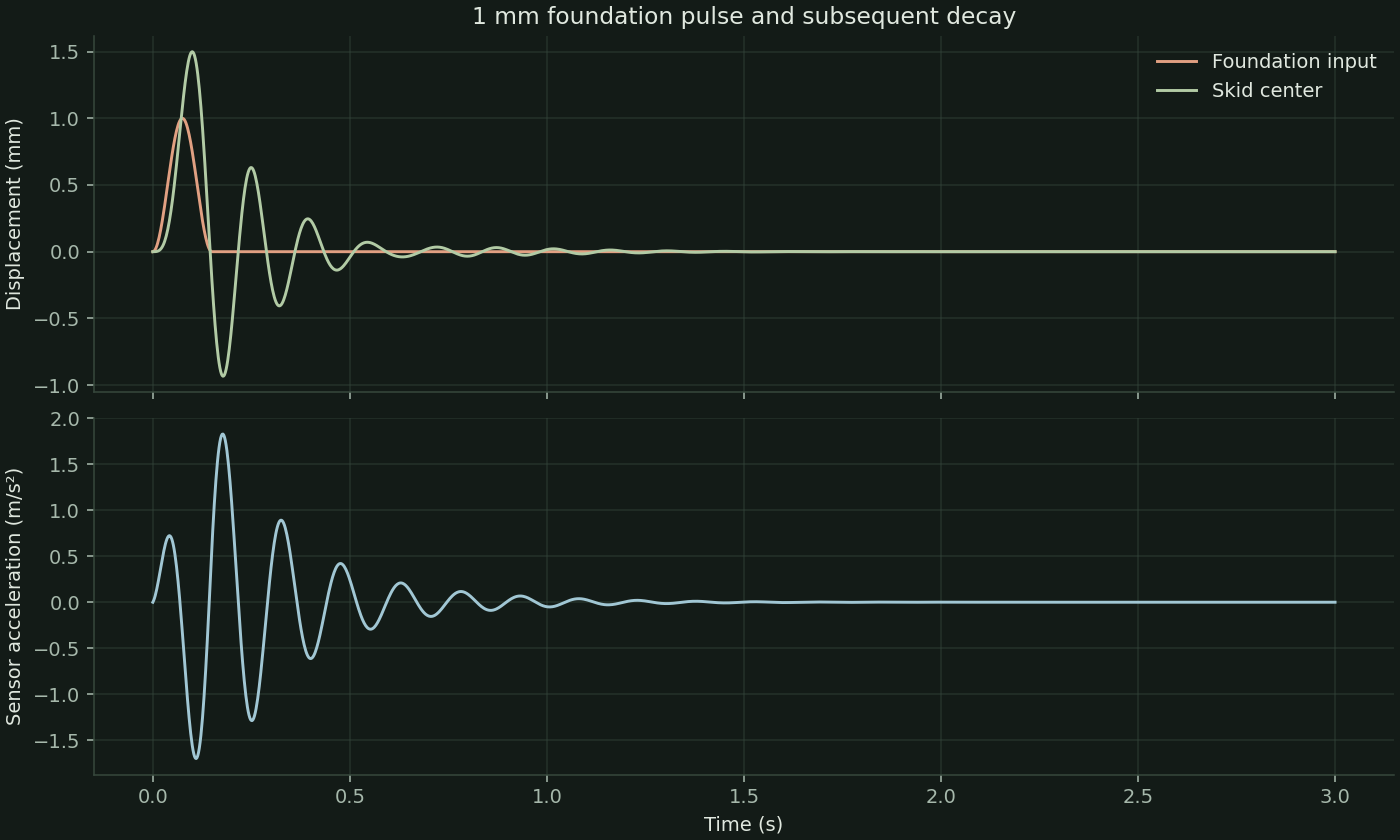
The selected design is integrated through startup, hold, stop and a foundation pulse at every uncertainty corner. Conservative peak sums cover arbitrary timing of the two disturbances.
Implicit stiffness derivatives, energy/work integrals and scalar/steady-state limits provide independent checks of the numerical model.
Inputs and assumptions
- 120 kg reference skid with 18 kg m² pitch inertia, support positions -0.42 m and +0.36 m, and 0.002 kg m rotating unbalance.
- Each support group represents a pair of linear spring/viscous-damper mounts sharing left/right load equally.
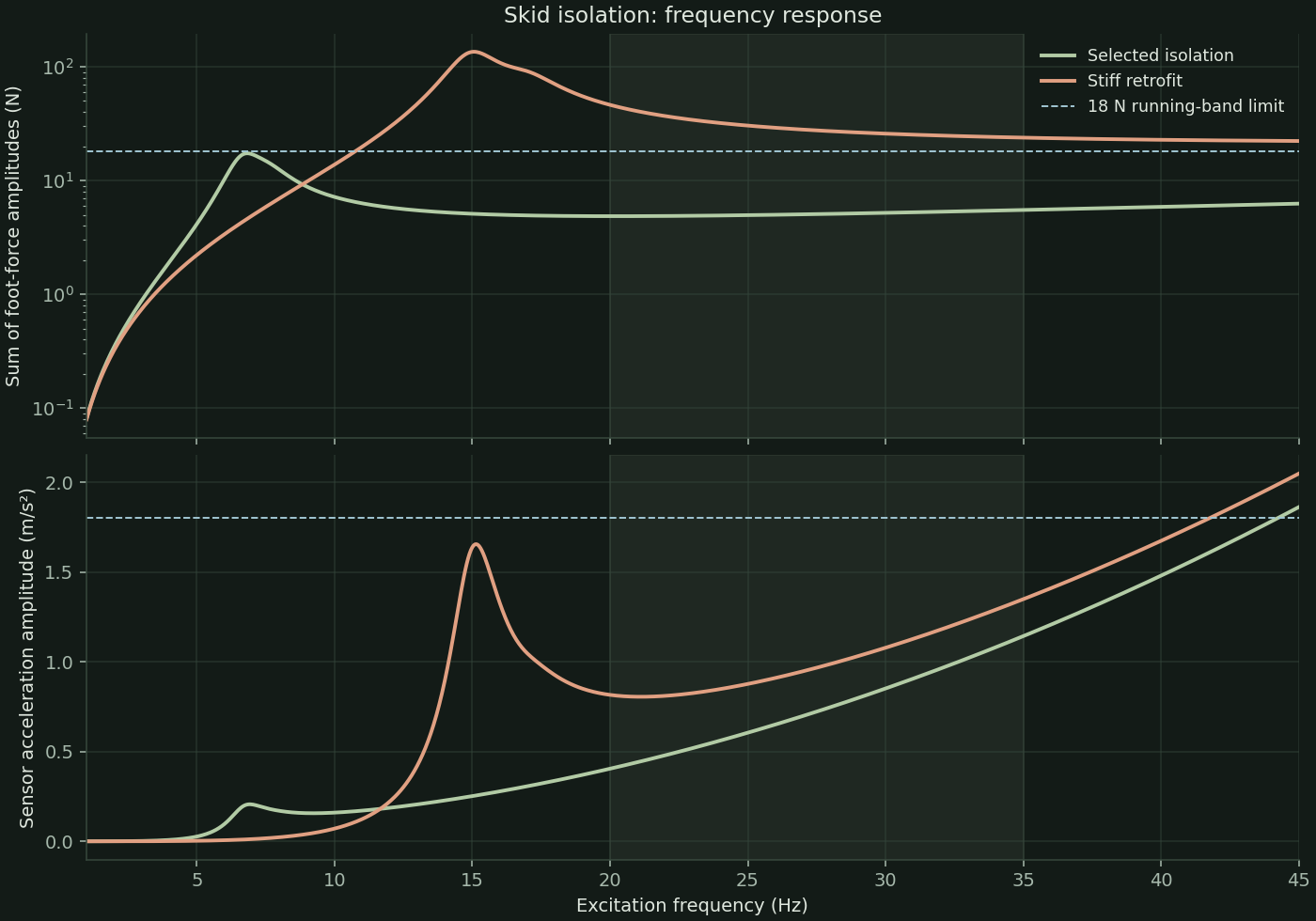
- The operating band is 20-35 Hz. Mass varies ±10%, CG shifts ±0.04 m, each support stiffness varies ±10%, and common damping varies ±20%.
- A 1 mm, 0.15 s foundation pulse is a synthetic design input. Pitch inertia scales with mass and is defined about the shifted CG.
Results
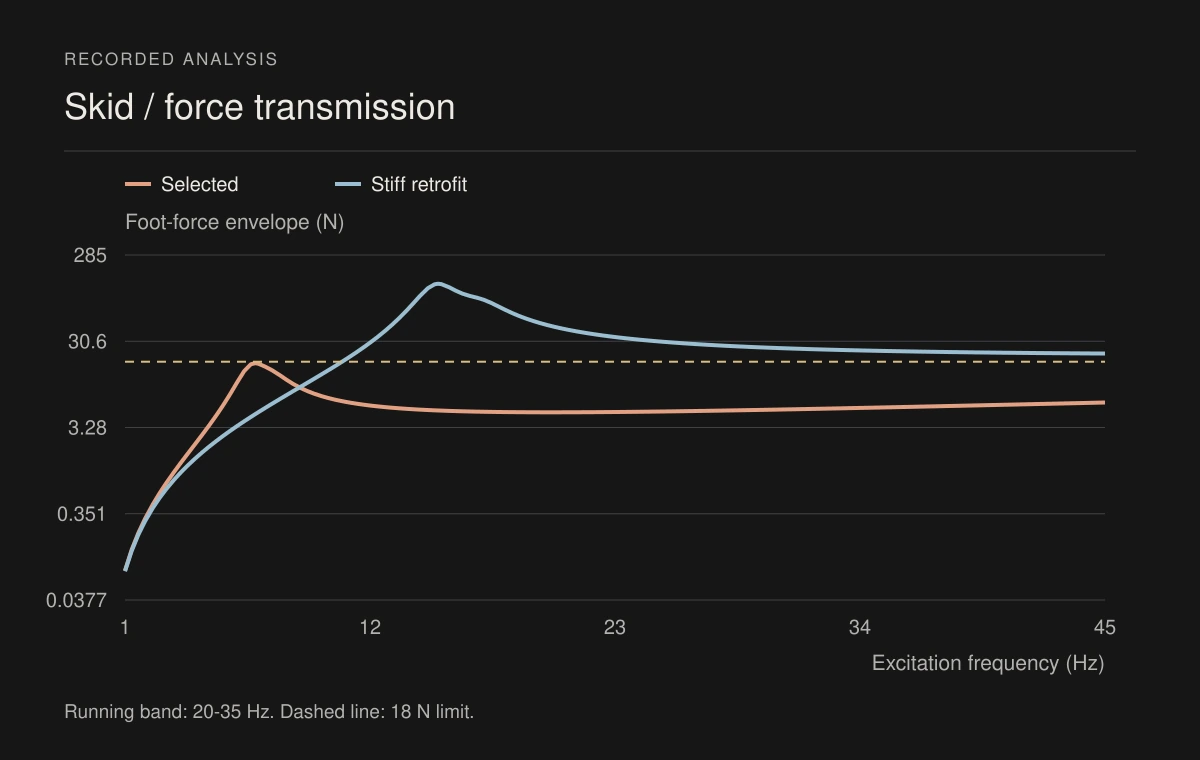
Skid force transmission
Compare the included analysis results.
| Candidate support combinations | 30 |
|---|---|
| Selected base pair stiffness | 120.0 kN/m |
| Selected damping parameter | 0.1 |
| Worst running-band foot-force envelope | 7.5769 N |
| Worst combined relative-motion bound | 1.26483 mm |
| Maximum combined support-pair load | 923.6 N |
| Executed uncertainty corners | 32 |
Report figures (5)
Verification
22 regression tests, 12 independent numerical checks and 19 acceptance checks pass. All 32 selected-design corners satisfy the declared operating and combined transient limits; the stiff retrofit is rejected for force transmission.
python run.pyAdditional scenarios
19 outcomes checked through executed numerical and synthetic dynamics study. The report lists the expected and observed outcomes for each check.
Read the validation report ↗Project files
The ZIP contains the source, inputs, results, and instructions. These files are also available individually.
- Coupled dynamics model and calculusmodel.py · 8 KB
- Candidate and uncertainty evaluationstudy.py · 8 KB
- Reference design inputsinputs.json · 1 KB
- Frequency-response resultsoutputs/frequency-response.csv · 74 KB
- Candidate search and rejectionsoutputs/candidate-grid.csv · 5 KB
- All selected-design corner outcomesoutputs/uncertainty-corners.csv · 9 KB
- Start/stop and energy traceoutputs/runup.csv · 824 KB
- Foundation-pulse traceoutputs/foundation-pulse.csv · 335 KB
- Coordinates and support schematicoutputs/model.svg · 2 KB
- Technical report and derivationsreport.html · 15 KB
- Independent numerical verificationvalidation.py · 5 KB
- Executed regression logoutputs/test-results.txt · 2 KB
- Executed acceptance auditcompletion/report.html · 5 KB
- Acceptance outcomes and source hashescompletion.json · 7 KB
Archive checksum
SHA-256
aae263b9df3e4037438cec009a26b5b7d2f0286134963e01a3b3266be61d969fRun locally
Python 3.11+ / NumPy 2.3.5 / SciPy 1.17.0 / Matplotlib 3.10.8
Extract the ZIP and open a terminal in the skid-vibration-isolation folder. The README includes setup and usage details.
python -m pip install -r requirements.txt
python run.py
python complete_validation.py
python -m unittest -v test_project.py
Limits
- The body is rigid with vertical and pitch motion only. Roll, lateral motion, frame flexibility, piping loads and floor flexibility are outside this model.
- Equivalent support stiffness and viscous damping are declared assumptions. No commercial mount properties, temperature dependence, creep or nonlinear contact were measured.
- The finite candidate/corner search is not a global optimum, a probability of success or a proof over every interior uncertain point.
- The transient peak bound includes 1% allowance, checked at nominal and limiting corners with finer output sampling. The pole-based decay indicator is not a universal initial-condition settling guarantee.
- This completes a numerical reference study and synthetic commissioning scenarios. No physical fabrication, fatigue qualification or field measurement is claimed.